
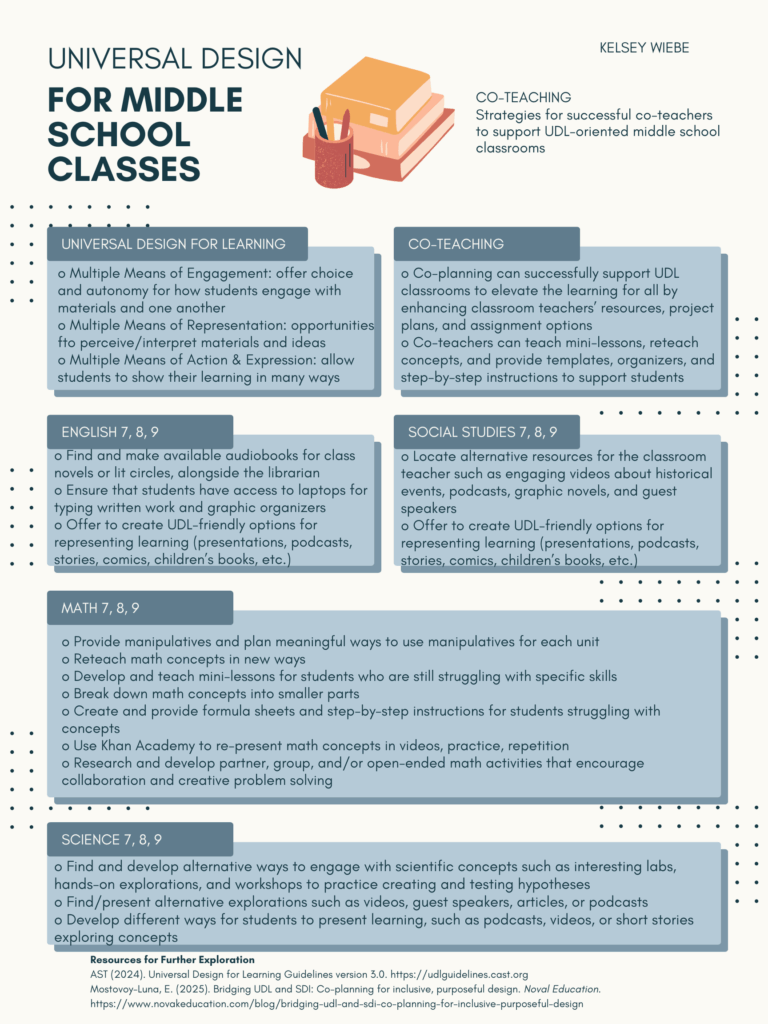
Co-teaching is an effective way to distribute resources and planning, and ensure that a diversity of learners are supported. Kokko, Takala, and Pihlaja (2021) emphasize reciprocity, collaboration, and mutual trust as being key to a good working relationship between co-teachers. Setting goals and ground rules is also mentioned as being essential, which fully makes sense.
Benefits in Finnish co-teaching include closer observation of students, less weight in regards to planning and differentiation because it was shared between teachers, and a greater ability to include everyone more fully in the class. Interestingly, the more time you spent co-teaching, the more useful Finnish teachers found it, and the fewer challenges they experienced. A major benefit that Finnish teachers identified was, surprisingly, the opportunity to share their feelings and experiences with someone else. What the authors referred to as “collective commitment” created outcomes and benefits that would not have happened in solo teaching (Kokko, Takala, and Pihlaja, 2021). “Collegial support” enhanced teacher well-being within the study (Kokko, Takala, and Pihlaja, 2021).
The principal challenge to co-teaching in Finland is shared planning time, which would also be something that we would likely encounter. A secondary challenge was finding a compatible and willing co-teacher, which I would also anticipate as being tough.
My school tried out a co-teaching model for two years, which I was a part of. We have moved on from it now, because it wasn’t wildly successful. I wish that I was taking part in it now, when I more fully understand co-teaching.
In my first year of teaching, I was assigned a co-teacher to support one of my five blocks of English 9. She was very helpful, and supported anyone who needed help. She pulled out students who had missed major sections of assignments or projects and re-taught them in her room. She offered to help me mark my school-wide writes, though I didn’t take her up on that (I have no idea why!). At the end of our tenure together, she created a debate unit for me to teach. She was very much a passive observer of my teaching, and generally did not plan or do any teaching herself. She functioned a bit more like an EA. She was very helpful and kind, and I appreciated her being there to ask for clarification on school rules, general approaches to things, and whether or not I was being insane.
The next year, I was given a job with a few blocks of resource. I was in my second year of teaching, and had no resource education, but I was expected to complete courses. I was assigned to three different classrooms to support. I was given zero parameters and did not at all understand this model or even realise it was a model. I approached the three classes with the same approach as my original co-teacher had taken, because that was really all that I knew. I also followed each separate teacher’s lead at all times. In hindsight, I definitely should have looked up co-teaching (not that I knew what it was called) and learned more about it, but I was very much just trying to survive each day.
In one class, I developed a friendship with the classroom teacher, and we admired and appreciated one another deeply. I supported students with their work, and helped differentiate assignments for them. I pulled students out occasionally to complete big projects or to teach them small lessons on material that they needed to better understand. I planned and taught a unit on debate. The other teacher and I worked well together, but it was very much her classroom, and I just supported her.
In another class, the teacher was deeply disinterested in co-teaching. Each time that I reported to her class, as instructed, she told me that she was fine and asked me to leave. Occasionally, she would send students who needed extra help to me, and I would happily support them. Often, they seemed to be troublemakers, and just needed to do their work in a quieter space. I honestly rarely got students from this teacher, and I constantly wondered whether I was doing enough in this class.
The third teacher was a hybrid of the first two. We developed a good working relationship, and I would stay in her class occasionally and support students as necessary with whatever they were working with. I worked more frequently with students with learning disabilities, but I would support everyone. I developed a good working relationship with all of the students in this class. For most classes, she would send me back to my classroom with the students who needed extra time or extra support. It was much less of a co-teaching model and more of a classic resource pull-out model, which we were apparently moving away from, but no one really articulated the model to either of us, and I was happy to take her lead and support her as necessary.
I think that the co-teaching model didn’t work the best in our school because no one explained what it was for and why, and what the expectations were. I think that teachers would have been much more on board if they understood what co-teaching was and why we were doing it. I think that all three classrooms that I supported, and the first one that I was supported in, would have been more successful if we had set common goals, spent time planning together, and identified what we each wanted our roles to be. I think that I could have been a lot more effective if I had set parameters around my role, and pursued those, in collaboration with the classroom teacher I was supporting.
I would like to develop and pursue a co-teaching model in my school in the future, where I plan together with other English 9 teachers, and work to share experiences and ideas. I would like to cultivate opportunities to co-teach with my fellow teachers, but I would ensure that I set goals, set roles and responsibilities, and regularly checked in about the working relationship.
References
AST. (2024). Universal design for learning guidelines version 3.0. https://udlguidelines.cast.org
Kokko, M., Takala, M., and Pihlaja, P. (2021). Finnish teachers’ views on co-teaching. British Journal of Special Education 48.1: pp. 112-132. https://doi-org.proxy.queensu.ca/10.1111/1467-8578.12348
Mostovoy-Luna, E. (2025). Bridging UDL and SDI: Co-planning for inclusive, purposeful design. Novak Education. https://www.novakeducation.com/blog/bridging-udl-and-sdi-co-planning-for-inclusive-purposeful-design